Error loading page.
Try refreshing the page. If that doesn't work, there may be a network issue, and you can use our self test page to see what's preventing the page from loading.
Learn more about possible network issues or contact support for more help.
Title details for The Jewish South by Shari Rabin - Available

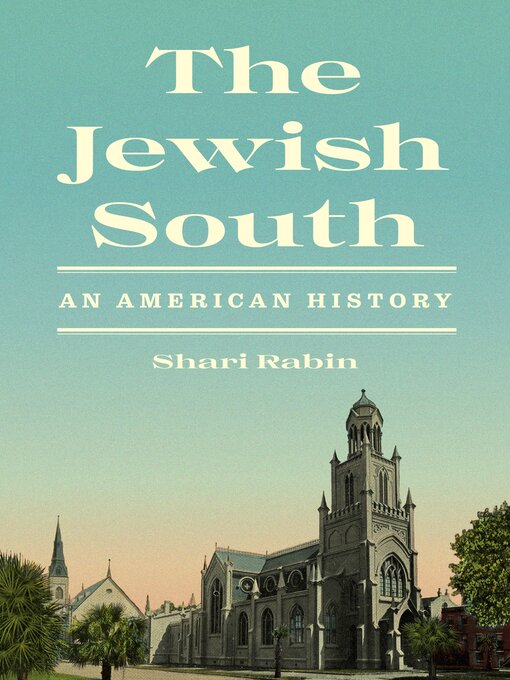
The Jewish South

An American History

ebook
2 of 2 copies available

A panoramic history of the Jewish American South, from European colonization to today
In 1669, the Carolina colony issued the Fundamental Constitutions of Carolina, which offered freedom of worship to "Jews, heathens, and other dissenters," ushering in an era that would see Jews settle in cities and towns throughout what would become the Confederate States. The Jewish South tells their stories, and those of their descendants and coreligionists who followed, providing the first narrative history of southern Jews.
Drawing on a wealth of original archival findings spanning three centuries, Shari Rabin sheds new light on the complicated decisions that southern Jews made—as individuals, families, and communities—to fit into a society built on Native land and enslaved labor and to maintain forms of Jewish difference, often through religious innovation and adaptation. She paints a richly textured and sometimes troubling portrait of the period, exploring how southern Jews have been targets of antisemitism and violence but also complicit in racial injustice. Rabin considers Jewish immigration and institution building, participation in the Civil War, the 1915 lynching of Leo Frank, and Jewish support for and resistance to the modern fight for Black civil rights. She examines shifting understandings of Jewishness, highlighting both the reality of religious diversity and the ongoing role of Christianity in defining the region.
Recovering a neglected facet of the American experience, The Jewish South enables readers to see the South through the eyes of people with a distinctive religious heritage and a southern history older than the United States itself.

  • Creators

  • Publisher

  • Release date

  • Formats

  • Accessibility

    The publisher provides the following statement about the accessibility of the EPUB file supplied to OverDrive. Experiences may vary across reading systems. After borrowing the book, you may download the EPUB files to read in another reading system.

    Summary

    This publication has been produced to meet accepted Accessibility standards and contains various accessibility features including concise image descriptions, a table of contents, a page list to navigate to pages corresponding to the print source version, and elements such as headings for structured navigation. Appearance of the text and page layout can be modified according to the capabilities of the reading system.

    Ways Of Reading

    • Appearance of the text and page layout can be modified according to the capabilities of the reading system (font family and font size, spaces between paragraphs, sentences, words, and letters, as well as color of background and text).

    • All content can be read as read aloud speech or dynamic braille.

    • Has alternative text descriptions for images.

    Conformance

    • The publication contains a conformance statement that it meets the EPUB Accessibility and WCAG 2 Level AA standard.

    • This publication claims to meet EPUB Accessibility 1.1 WCAG 2.2 Level AA.

    Navigation

    • Table of contents to all chapters of the text via links.

    • Index with links to referenced entries.

    • Page list to go to pages from the print source version.

    Additional Information

    • Page breaks included

  • Languages

  • Reviews

    • Kirkus

      February 1, 2025
      The children of Israel, down in Dixie. In an 1899 essay, "Concerning the Jews," Mark Twain wrote of the "immense Jewish population" of the United States--"down to the least little village." Rabin's engaging study confirms Twain's assessment by documenting throughout the South the breadth of Jewish settlement, from the colonial era to modern times. Rabin is a scholar at Oberlin College, but her prose is light on theory and mostly free of academic jargon, and her deep archival research reveals how Jews participated in and were shaped by a dominant culture in which their status could be uncertain. Jews began to arrive in the South by the early 18th century and were usually afforded the same political rights as white Protestants. This privileged status enabled Jews to hold enslaved people, and they did so in roughly the same proportion as the rest of the white population. Cultural norms could disadvantage Jews (e.g., Sunday closing laws), but the fact that Charleston's Hebrew Benevolent Society and Hebrew Orphan Society marched in the funeral cortege of pro-slavery Sen. John C. Calhoun shows that Jews were often eager to be seen as "proud white South Carolinians." Reflecting Enlightenment values, Jewish synagogues and religious practice transformed to reflect the culture Jews hoped to join. Support for the Civil War and later the Lost Cause narrative, though not universal, ran deep. Indeed, during the Wilmington, North Carolina, massacre of 1898, a coup d'etat that forcibly removed the elected biracial government, former Mayor Solomon Fishblate declared, "The choice in this election is between white rule and Negro rule. And I am with the white man, every time!" Yet as the gathering antisemitism of the early 20th century made abundantly clear, Jews could never rest easy. In Rabin's words, they "were privilegedand vulnerable, political powerbrokersand targets of hate crimes." A rich account of how the Jewish minority claimed its place in Southern culture even as it retained its identity.

      COPYRIGHT(2025) Kirkus Reviews, ALL RIGHTS RESERVED.

Formats

  • Kindle Book
  • OverDrive Read
  • EPUB ebook

Languages

  • English

Loading
