Error loading page.
Try refreshing the page. If that doesn't work, there may be a network issue, and you can use our self test page to see what's preventing the page from loading.
Learn more about possible network issues or contact support for more help.
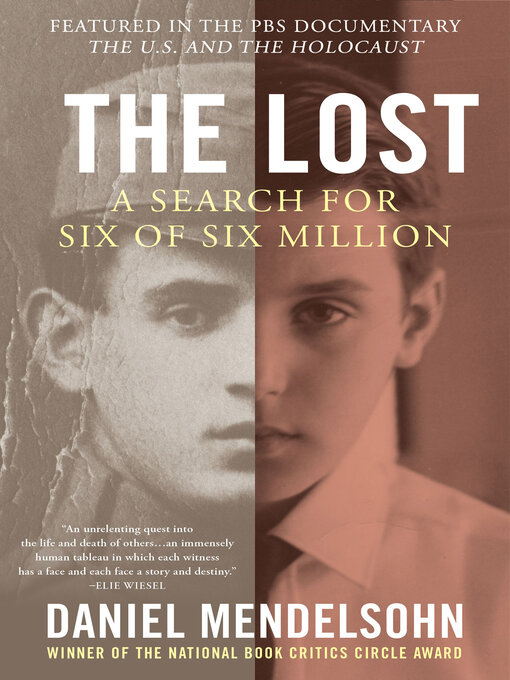
Title details for The Lost by Daniel Mendelsohn - Available

The Lost

A Search for Six of Six Million

ebook
1 of 1 copy available

When Daniel Mendelsohn was a child, the Holocaust was a topic never to be discussed. His family was haunted by the disappearance of six relatives during that time, a mystery that intrigued him for years. The Lost is the story of Mendelsohn's search for his missing family members, a quest that took him to twelve countries on four continents, and forced him to confront the many discrepancies between the lives we live and the stories we tell.

Deftly moving between past and present, The Lost transforms the story of one family into a profound meditation on our fragile hold on the past. Suspenseful, deeply personal, and beautifully written, this literary tour de force illuminates what is lost, and found, through the passage of time.

Daniel Mendelsohn is a regular contributor to The New York Review of Books and also writes for The New Yorker, the New York Times Book Review, and the New York Times Magazine. He is a winner of the National Book Critics Circle Award for Excellence in Criticism and is the author of The Elusive Embrace. Mendelsohn holds the Charles Ranlett Flint Chair in Humanities at Bard College. He lives in New York City and Trenton, New Jersey.

"Mendelsohn succeeds in assembling an immensely human tableau in which each witness has a face and each face a story and destiny." — Elie Wiesel, Washington Post Book World

  • Creators

  • Publisher

  • Release date

  • Formats

  • Accessibility

    The publisher provides the following statement about the accessibility of the EPUB file supplied to OverDrive. Experiences may vary across reading systems. After borrowing the book, you may download the EPUB files to read in another reading system.

    Ways Of Reading

    • No information about appearance modifiability is available.

    • Not all of the content will be readable as read aloud speech or dynamic braille.

    Conformance

    • No information is available.

    Navigation

    • Table of contents to all chapters of the text via links.

  • Languages

  • Reviews

    • Publisher's Weekly

      Starred review from July 24, 2006
      As a boy in the 1960s, Mendelsohn could make elderly relatives cry just by entering the room, so much did he resemble his great-uncle Shmiel Jäger, who had been "killed by the Nazis." This short phrase was all Mendelsohn knew of his maternal grandfather Abraham's brother, who had remained with his wife and four daughters in the Ukrainian shtetl of Bolechow after Abraham left for America. Long obsessed with family history, Mendelsohn (The Elusive Embrace
      ) embarked in 2001 on a series of journeys to learn exactly what had happened to Shmiel and his family. The result is a rich, ruminative "mythic narrative... about closeness and distance, intimacy and violence, love and death." Mendelsohn uses these words to describe the biblical story of Cain and Abel, for one of the book's most striking elements is the author's recounting of the book of Genesis in parallel with his own story, highlighting eternal themes of origins and family, temptation and exile, brotherly betrayal, creation and annihilation. In Ukraine, Australia, Israel and Scandinavia, Mendelsohn locates a handful of extraordinary, aged Bolechow survivors. Especially poignant is his relationship with novelist Louis Begley's 90-year-old mother, from a town near the shtetl, an irascible, scene-stealing woman who eagerly follows Mendelsohn's remarkable effort to retrieve her lost world. B&w photos, maps.

    • Booklist

      Starred review from August 1, 2006
      As a boy, Mendelsohn was not only entranced by the stories his grandfather told about growing up in the little Galician town of Bolechow but also attuned to the sorrow that shadowed every tale: his grandfather's oldest brother, Shmiel, his wife, and their four daughters had been killed by the Nazis. So affected was Mendelsohn by his legacy, he eventually embarked on a quest to find out exactly what happened to his six lost relatives. A classicist and formidable literary critic, Mendelsohn performs extraordinary feats of factual and emotional excavation in this finely wrought, many-faceted narrative, a work best described as Talmudic. Autobiography is entwined with revelatory commentary on the Torah, while his affecting chronicle of his journeys to Israel, Australia, Stockholm, Vienna, and, most movingly, Bolechow itself set the stage for Mendelsohn's sometimes perplexing, always intense conversations with his newly discovered cousins. Shmiel, Ester, Lorka, Frydka, Ruchele, and Bronia gradually come into focus, as does a shocking vision of the hell Bolechow became as neighbors tortured and murdered neighbors. Mendelsohn's tenacious yet artistic, penetrating, and empathic work of remembrance recalibrates our perception of the Holocaust and of human nature. (Reprinted with permission of Booklist, copyright 2006, American Library Association.)

    • Library Journal

      July 1, 2006
      Mendelsohn (humanities, Bard Coll.; "The Elusive Embrace") opens this new work by describing his relationship with his story-telling grandfather and the latter -s almost deafening silence about the fate of a brother, Shmiel, killed by the Nazis. While the book revolves around the author -s decades-long search to discover the fate of his great uncle -s family, this quest also leads to the compilation of a family genealogy and the discovery of various living relatives throughout the diaspora. Such stories of genealogical and historical investigations will often move into a meditation on inner discoveries, frequently embellished with epiphanies of religious or spiritual awakening or the rediscovery of an ethnic heritage. Mendelsohn does engage in some personal meditation on family relations and his Jewishness and intersperses his narrative with analysis from various" Parasha", the weekly Torah portions that analyze biblical texts relating to suffering and memory. More than just the discovery of lost relatives, however, his journey serves as an exposé of the memory of those who mourn the dead and of the dead who have no one left to mourn them. While occasionally burdened with excessive detail, the book illustrates the enduring legacy of the Holocaust in contemporary Jewish life. Recommended for public libraries. [See Prepub Alert, "LJ "5/1/06.]" -Frederic Krome, Jacob Rader Marcus Ctr. of the American Jewish Archives, Cincinnati"

      Copyright 2006 Library Journal, LLC Used with permission.

Formats

  • Kindle Book
  • OverDrive Read
  • EPUB ebook

Languages

  • English

Loading
