Error loading page.
Try refreshing the page. If that doesn't work, there may be a network issue, and you can use our self test page to see what's preventing the page from loading.
Learn more about possible network issues or contact support for more help.
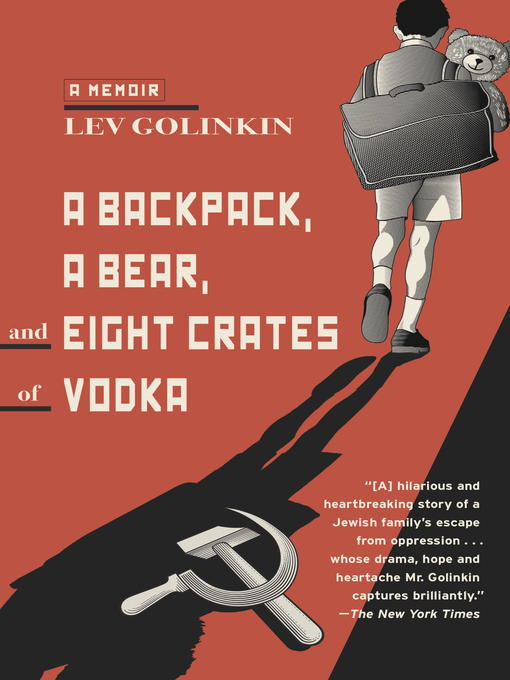
Title details for A Backpack, a Bear, and Eight Crates of Vodka by Lev Golinkin - Available

A Backpack, a Bear, and Eight Crates of Vodka

A Memoir

ebook
1 of 1 copy available
A compelling memoir—"hilarious and heartbreaking" (The New York Times)—of two intertwined journeys: a Jewish refugee family in Ukraine fleeing persecution and a young man seeking to reclaim a shattered past
In the twilight of the Cold War (the late 1980s), nine-year old Lev Golinkin and his family cross the Soviet border, leaving Ukraine with only ten suitcases, $600, and the vague promise of help awaiting in Vienna. Years later, Lev, now an American adult, sets out to retrace his family's long trek, locate the strangers who fought for his freedom, and in the process, gain a future by understanding his past.
This is the vivid, darkly comic, and poignant story of Lev Golinkin in the confusing and often chilling final decade of the Soviet Union, and "of a Jewish family’s escape from oppression ... whose drama, hope and heartache Mr. Golinkin captures brilliantly” (The New York Times). It's also the story of Lev Golinkin as an American man who finally confronts his buried past by returning to Austria and Eastern Europe to track down the strangers who made his escape possible ... and say thank you.
Written with biting, acerbic wit and emotional honesty in the vein of Gary Shteyngart, Jonathan Safran Foer, and David Bezmozgis, Golinkin's search for personal identity set against the relentless currents of history is more than a memoir—it's a portrait of a lost era. This is a thrilling tale of escape and survival, a deeply personal look at the life of a Jewish child caught in the last gasp of the Soviet Union, and a provocative investigation into the power of hatred and the search for belonging. Lev Golinkin achieves an amazing feat—and it marks the debut of a fiercely intelligent, defiant, and unforgettable new voice.
  • Creators

  • Publisher

  • Release date

  • Formats

  • Accessibility

    The publisher provides the following statement about the accessibility of the EPUB file supplied to OverDrive. Experiences may vary across reading systems. After borrowing the book, you may download the EPUB files to read in another reading system.

    Summary

    Accessibility metadata derived programmatically based on file type.

    Ways Of Reading

    • Appearance of the text and page layout can be modified according to the capabilities of the reading system (font family and font size, spaces between paragraphs, sentences, words, and letters, as well as color of background and text).

    • Not all of the content will be readable as read aloud speech or dynamic braille.

    Conformance

    • No information is available.

    Navigation

    • Table of contents to all chapters of the text via links.

    Additional Information

    • Color is not the sole means of conveying information

  • Languages

  • Reviews

    • Publisher's Weekly

      July 21, 2014
      In late 1989, an 11-year-old Golinkin and his family joined the Jewish diaspora from what would soon be the former Soviet Union. Despite having little connection to their Jewish heritage, the Golinkins had been harassed, bullied, and seen their prospects blocked due to their ethnicity. Their exile brought them first to Austria, where they developed an important friendship with a local baron whose father was an unrepentant Nazi. Soon after, they received asylum in the college town of West Lafayette, Ind. Decades later, Golinkin retraced his journey and interviewed the people who had made his escape possible. Golinkin convincingly portrays the miseries, and rare joys, of his bullied, furtive childhood, and the limits it put on him. As he takes on an American identity, he rejects every aspect of his previous life, from its language to a faith he barely knew, a rejection that includes his choice of colleges (he attended the Roman Catholic Boston College).Trauma and his attempts to deal with it give substance to his book, although Golinkin supplements his memories with interviews and research that add important context. While the narrative grows choppy at the end as it devolves into a series of postscripts, Golinkin has created a deeply moving account of fear and hope.

    • Kirkus

      September 15, 2014
      An ex-Iron Curtain refugee-turned-American citizen tells the emotional story of how he and his parents fled the Ukraine two years before the collapse of the Soviet Union.Golinkin was 11 years old when he and his family went into exile. They were among thousands of other Jews seeking political asylum and an end to the anti-Semitism that they and their ancestors before them had been forced to endure. The family was secular; however, that fact did nothing to protect them from harassment and social oppression. The trauma ran so deep that Golinkin developed a severe case of self-hatred that haunted him into adulthood. The family's path away from the Soviet Union took them to Vienna, where two American Jewish aid organizations assisted them and other refugees in beginning the long process toward finding homes in Israel and the West. The family encountered an Austrian baron named Peter. Driven by anguish over his father's Nazi past, Peter helped get Golinkin's father a temporary job to rebuild lost work credentials and prepare him for future gainful employment rather than a life condemned to "delivering pizzas and driving taxis." Eventually, the family settled in West Lafayette, Indiana, where Golinkin's sister was accepted into the Purdue graduate engineering program even though she, like her father, had been stripped of all credentials. Meanwhile, the author rejected every aspect of his former life, including his faith and language, and chose to go to a Roman Catholic college in Boston. Yet ironically, it was in this most un-Jewish of settings where he would begin the process of breaking through years of accumulated anger, pain and rage and accepting himself as a Jew. While the narrative becomes increasingly fractured near the end of the book, Golinkin still manages to impact readers with the force of his unflinching honesty. A mordantly affecting chronicle of a journey to discover that "you can't have a future if you don't have a past."

      COPYRIGHT(2014) Kirkus Reviews, ALL RIGHTS RESERVED.

    • Booklist

      October 15, 2014
      Golinkin was just a child during the tumultuous years of Soviet premier Gorbachev's introduction of glasnost and perestroika, yet his parents and grandmother remembered the worst of the USSR's restrictive, controlling atmosphere. Worse, the family members were zhid, Jewish. This atmospheric, touching memoir, whose chapters begin with dates and locations to orient the reader, follows the Golinkins as they escape the Soviet Union and land in America. Golinkin's early memories are touchingly true to those of a youngster, and he reports on his family members' fears, troubles, persistence, and patience with a keen eye and a memorable voice. Once in the U.S., ensconced near Purdue Universitythe former-engineer father a clerk, the former-doctor mother a barista, and hopes for his sister's attending Purdue waveringGolinkin muses, Dignity, family, social status, or blood, one way or another, every immigrant pays the admission price to America, and the older they are, the steeper the fare. Years later, Golinkin finds and thanks the many people who helped his family and inspired him to help others as well. Eye-opening for those who come to the U.S. and for those who help them do so.(Reprinted with permission of Booklist, copyright 2014, American Library Association.)

    • BookPage
      “Running a totalitarian regime is simple: tell the people what they’re going to do, shoot the first one to object, and repeat until everyone is on the same page.” Such was life in Ukraine for young Lev Golinkin and his family, and it might have been tolerable had he not also suffered daily beatings in school for being a Jew. When the Soviet Union collapsed, the family fled to Austria where they lived in a refugee hotel before immigrating to the U.S. A Backpack, a Bear, and Eight Crates of Vodka is the story of that journey and of Golinkin’s struggle to reclaim his identity. When the family finally makes it to the America extolled in folk songs and held out as their greatest hope, assimilating is as hard as you might imagine. Golinkin’s father, an engineer in the Ukraine, spends eight months sending out resumes in order to land an entry-level job in his field. His mother, a doctor, struggles with the language barrier while pulling espresso shots as a barista. Lev and his sister Lina are the family’s great hope, but while she studies, he struggles to dismantle his internalized anti-Semitism. Golinkin writes with dry humor about his experience but connects emotionally when describing how a lengthy stint doing charity work in college finally led him to investigate his past and the people whose charity made his own life not just better, but possible at all. A friend in Vienna steered them to Indiana so they wouldn’t be lost among refugees in Brooklyn, and the efforts expended to get the children into college were heroic. A Backpack, a Bear, and Eight Crates of Vodka blends memoir and history into an intimate tale of personal growth.   This article was originally published in the November 2014 issue of BookPage. Download the entire issue for the Kindle or Nook.

Formats

  • Kindle Book
  • OverDrive Read
  • EPUB ebook

Languages

  • English

Loading