Error loading page.
Try refreshing the page. If that doesn't work, there may be a network issue, and you can use our self test page to see what's preventing the page from loading.
Learn more about possible network issues or contact support for more help.
Title details for Tasha by Brian Morton - Wait list

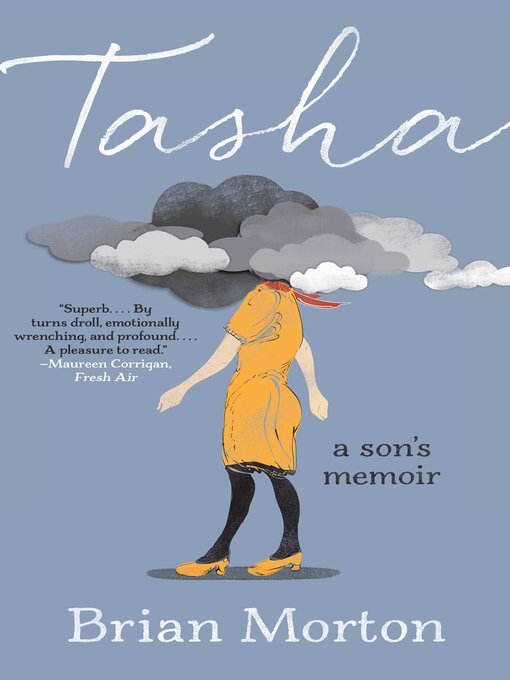
Tasha

A Son's Memoir

ebook
0 of 0 copies available
A Washington Post Best Nonfiction Book of the Year

In the spirit of Fierce Attachments and The End of Your Life Book Club, acclaimed novelist Brian Morton delivers a "superb" (Maureen Corrigan, Fresh Air), darkly funny memoir of his mother's vibrant life and the many ways in which their tight, tumultuous relationship was refashioned in her twilight years.
Tasha Morton is a force of nature: a brilliant educator who's left her mark on generations of students—and also a whirlwind of a mother, intrusive, chaotic, oppressively devoted, and irrepressible.

For decades, her son Brian has kept her at a self-protective distance, but when her health begins to fail, he knows it's time to assume responsibility for her care. Even so, he's not prepared for what awaits him, as her refusal to accept her own fragility leads to a series of epic outbursts and altercations that are sometimes frightening, sometimes wildly comic, and sometimes both.

Clear-eyed, "deeply stirring" (Dani Shapiro, The New York Times Book Review), and brimming with dark humor, Tasha is both a vivid account of an unforgettable woman and a stark look at the impossible task of caring for an elderly parent in a country whose unofficial motto is "you're on your own."
  • Creators

  • Publisher

  • Release date

  • Formats

  • Accessibility

    The publisher provides the following statement about the accessibility of the EPUB file supplied to OverDrive. Experiences may vary across reading systems. After borrowing the book, you may download the EPUB files to read in another reading system.

    Summary

    A simple complexity publication with some images, converted to meet EPUB Accessibility specifications of WCAG-AA level. This book contains various accessibility features such as alternative text for images, table of contents, page-list, landmark, reading order, structural navigation, and semantic structure.

    Ways Of Reading

    • Appearance of the text and page layout can be modified according to the capabilities of the reading system (font family and font size, spaces between paragraphs, sentences, words, and letters, as well as color of background and text).

    • All content can be read as read aloud speech or dynamic braille.

    • Has alternative text descriptions for images.

    Conformance

    • The publication contains a conformance statement that it meets the EPUB Accessibility and WCAG 2 Level AA standard.

    • This publication claims to meet EPUB Accessibility 1.0 WCAG 2.0 Level AA.

    Navigation

    • Table of contents to all chapters of the text via links.

    • Elements such as headings, tables, etc for structured navigation.

    Additional Information

    • Page breaks included

  • Languages

  • Reviews

    • Library Journal

      November 1, 2021

      In Where the Children Take Us, CNN anchor Asher celebrates the strength of her first-generation British Nigerian mother, who overcame grief when her husband was killed in a South London car accident to raise four accomplished children, including Oscar-nominated actor Chiwetel Ejiofor (125,000-copy first printing). Multi-award-winning novelist Morton writes about his fierce and irrepressible educator mother, Tasha, from whom he spent a lifetime carefully cushioning himself and who still proves a handful when he must intervene as caregiver as she grows older (75,000-copy first printing). Author of the laugh-out-loud best seller I Miss You When I Blink, self-professed worrywart Philpott practically built a Bomb Shelter to protect her children, then realized during the crisis that unfolded after she found her teenage son unconscious on the floor that she couldn't control everything (100,000-copy first printing). Forever Boy, Swenson's account of raising a son with severe autism, should attract a big audience--and not just because of the subject's importance; Swenson's blog/Facebook page Finding Cooper's Voice has 655,000 followers, and her TODAY-featured video, "The Last Time It's Going To Be Okay," has been viewed over 30 million times (75,000-copy first printing). Expanding on a 2018 USA TODAY story that has had more than 1.5 million page views, Trujillo examines the aftermath of her mother's suicide in Stepping Back from the Ledge, explaining that she had to face deep sorrows in her mother's life and her own.

      Copyright 2021 Library Journal, LLC Used with permission.

    • Publisher's Weekly

      Starred review from January 3, 2022
      The tumultuous bond between a mother and son animates this unstinting yet tender work from novelist Morton (Florence Gordon). When, after years of “successfully her at arm’s length,” Morton’s mother’s worsening dementia forced the two of them to reconnect, Morton aired his frustrations on paper. While he confesses to satirizing his difficult and “voluble Jewish mother” in his novel, The Dylanist, he offers a more nuanced look here at the woman who believed “the people she loved were depriving her.” Morton details how his octogenarian mother, Tasha—once a sharp-witted New Jersey teacher—slowly lost her memory, and how he and his sister struggled to find her care in the process (“We got the names of people who could supposedly guide us... but it turned out that they too were working in the dark”). Despite Tasha’s obstinacy—which only grew as her health declined—Morton describes her antics with measured compassion and gallows humor. Contemplating her last words—“Go to hell.... I hate you”—he crafts an imagined deathbed monologue for Tasha, a single-sentence two-page tour de force that paints her complexities in a humanizing light (“Who I was is just too much for you,” she explains). Part gut-punch comedy, part eulogy, this tribute is dazzling. Agent: Henry Dunow, Dunow, Carlson, & Lerner.

    • Kirkus

      February 1, 2022
      A son's search for his mother. In 1991, award-winning novelist Morton fictionalized his mother in his first novel, The Dylanist. "Her eccentricities, he admits, "made it hard for me to resist a comic portrayal"--a portrayal that wounded her. Now, after her death, Morton tries to understand how she became the stubborn, overbearing woman who blighted his emotional life. When she was younger, he knew, she had been defiant and determined; at 16, she left home and changed her name from Esther to Tasha, "partly because she liked the sound and partly because it wasn't the name of anyone she knew." Tasha became the first copy girl at the Daily Worker, and she also worked for the United Office and Professional Workers of America, where she met the man she would marry. When he dallied in proposing, she took off to a kibbutz for six months. Married at last and with two young children, she returned to school to earn a graduate degree in education, going on to become an innovative teacher and active school board member. Yet after her husband died suddenly in 1984, she started hoarding--filling her house with the "detritus of her despair"--and sank into depression, the depths of which she confessed to her diary. She felt, Morton realized, "as if she loved us more than any of us loved her." After a stroke and increasing dementia made it impossible for her to care for herself at home, Morton and his sister tried to find support for her only to discover the dearth of resources for the elderly and their vulnerability to abuse. The author's revised portrayal of Tasha is both comic and tender. He recounts frustrating, absurd conversations and discovers, as well, "a life that was devoted to making a contribution. What I see is the life of a woman who gave of herself as fully as she could." His affecting memoir reveals a desperate woman railing against indignities and loneliness and a son powerless to assuage her pain. Melancholy and familial devotion imbue a nuanced, poignant portrait.

      COPYRIGHT(2022) Kirkus Reviews, ALL RIGHTS RESERVED.

    • Booklist

      March 1, 2022
      At a certain point in most people's lives, the parent and the child switch roles, whether due to disease, injury, or just plain aging. It becomes the child's responsibility to keep parents housed, fed, entertained, and safe, a duty that comes with baggage. Even good relationships are challenged when aging parents insist on driving when they can't really see or living alone despite a series of falls. Morton's mother, Tasha, was a gifted teacher and outspoken supporter of education, but Morton was never sure where he fit into her life. In their final time together, he tries to understand a woman who remains feisty while losing herself to dementia. Morton has an appealing style and shares his challenges (including finding a welcoming nursing home and spying on the home health worker Tasha claims verbally abuses her) with a dose of humor and self-deprecation. He's also honest about his hesitancy to bring his mother into his own home and his own feelings of inadequacy. This is a personal story, but anyone facing the same challenges will be nodding along in agreement.

      COPYRIGHT(2022) Booklist, ALL RIGHTS RESERVED.

    • Library Journal

      February 1, 2022

      In his latest work, a son's loving and hard reflection on his mother, novelist Morton (Starting Out in the Evening) does his best to piece together the complex woman his mother was--from the progressive elementary school teacher, to the scatterbrained woman he remembered, to a woman in mental decline after the death of her husband. Morton attempts to see his mother as a "whole," outside of the eccentricities he experienced as her child. His memoir takes in his mother's journal entries, which offered a window into her inner life and revealed secrets Morton hadn't been aware of during his youth. At times, he steps out of his narrative briefly to comment on the state of health care and elder care in the United States and to air his frustrations with how these systems affected him and his mother. Still, Morton's writing is conversational and engaging throughout, offering a vivid portrait of a sometimes-hilarious, sometimes-challenging relationship between a mother and son. VERDICT This is a charming and sad memoir, reminding readers of life's inevitabilities, the beauty of the journey, and the lesson to hold on to those close to them with a fierceness.--Amanda Ray

      Copyright 2022 Library Journal, LLC Used with permission.

    • BookPage
      To say that Brian Morton’s mother, Tasha, was “a woman of stubborn energy” is an understatement; from start to finish, she was a bona fide contrarian. For instance, after agreeing to a short trial stay at an assisted living residence in Teaneck, New Jersey, she literally did an about-face on move-in day. “I’m not going in there,” she said. “Take me home instead. Or take me to the city dump. Just dump me with the chicken bones. Or better yet, take me to the cemetery. Save yourself a trip later on.” Refusing to even step inside, she simply walked away, and Morton later found her sitting on someone’s porch, eating a banana. Such are the myriad confrontations Morton describes in his hilarious yet tender memoir, Tasha. A novelist and professor at Sarah Lawrence College, he had spent much of his life trying to maintain distance from his mother, whose concept of boundaries could generously be described as “loose.” In junior high, if he was late for dinner, she would begin calling friends, hospitals and the police to search for him. Once he became an adult, she had little inclination to loosen the reins. However, once her health began to fail in 2010, after a stroke and the onset of dementia, Morton knew he had no choice but to step in. At the age of 60, Morton was already juggling the demands of both his career and his family, including two sons in middle school. He is wonderfully honest about his hesitation to take on additional responsibilities for a parent or navigate the duties of the sandwich generation. He’s also careful to paint a complete picture of his mother’s life, including her nonstop educational activism and excellence as a pioneering elementary school teacher, particularly with disabled students. When Tasha’s husband suddenly died in 1984, she retired and sank into a despondency (likely undiagnosed depression) that she never overcame. Hoarding ensued, and in one memorable scene, Morton can’t convince his mother to throw away even one of five swizzle sticks—the mere tip of a true iceberg. Morton excels at bringing his novelist’s eye to many such standoffs, including picking up his mother at the police station on more than one occasion. As he addresses the harsh realities of taking away a parent’s independence, trying to make that parent happy and trying (and failing) to procure adequate care, his superb storytelling skills add a helpful dose of levity. As a result, Tasha takes a difficult topic and transforms it into a soulful and often funny memoir about spirited mothers, refreshingly told from a son’s point of view. The book’s unique ending, which gives Tasha the last word, is an absolute tour de force.

Formats

  • Kindle Book
  • OverDrive Read
  • EPUB ebook

Languages

  • English

Loading